If you are importing from China to the United States, United Kingdom, Germany, France, Italy, Netherlands, Canada, Australia, UAE, Saudi Arabia, Singapore or other major global markets, selecting the right international payment method is critical to protecting your capital and ensuring smooth transactions.
Among common international payment methods such as Telegraphic Transfer (T/T), Open Account, Documentary Collection, and escrow services, the Letter of Credit (L/C) remains one of the most secure and structured solutions for medium to large international trade transactions.
Many importers still ask what exactly a Letter of Credit is, what the difference is between Import L/C and Export L/C, how the L/C process works in practice, and whether L/C is safer than T/T. This guide explains everything clearly so you can make informed financial decisions in global trade.
If you are sourcing products from China and need full support—from supplier sourcing to inspection and shipping coordination—you can explore our services at https://ucsourcing.com/our-services/
What Is a Letter of Credit (L/C)?
A Letter of Credit is a bank-issued financial instrument that guarantees payment to a seller (exporter) once specific documentary conditions are met. In international trade, buyers worry suppliers may not ship goods after receiving payment, while suppliers worry buyers may refuse payment after shipment. An L/C replaces mutual trust with bank-backed assurance.
The most important principle of L/C transactions is that banks deal with documents, not goods. If documents strictly comply with L/C terms, payment must be made—even if later disputes arise regarding product quality or performance. This document-based mechanism makes L/C secure but also strict.
Import L/C vs Export L/C
An Import Letter of Credit is opened by the buyer’s bank at the request of the importer. It guarantees payment to the exporter upon compliant documentation. For importers, this protects against advance payment risk, improves credibility with suppliers, and allows better cash flow management.
An Export Letter of Credit is the same instrument viewed from the exporter’s perspective. Once received and authenticated by the advising bank, it becomes a secure payment guarantee. For exporters, it reduces non-payment risk and provides confidence to proceed with production and shipment.
| Aspect | Import L/C | Export L/C |
|---|---|---|
| Opened By | Buyer’s bank | Received by exporter |
| Protects | Importer | Exporter |
| Purpose | Guarantees payment after shipment | Ensures payment upon document compliance |
| Risk Reduction | Avoids prepayment exposure | Avoids buyer default risk |
Step-by-Step Letter of Credit Process
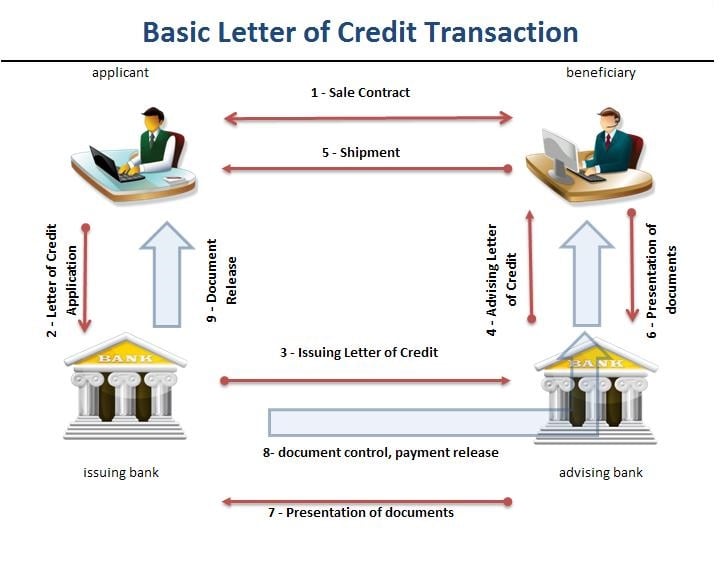
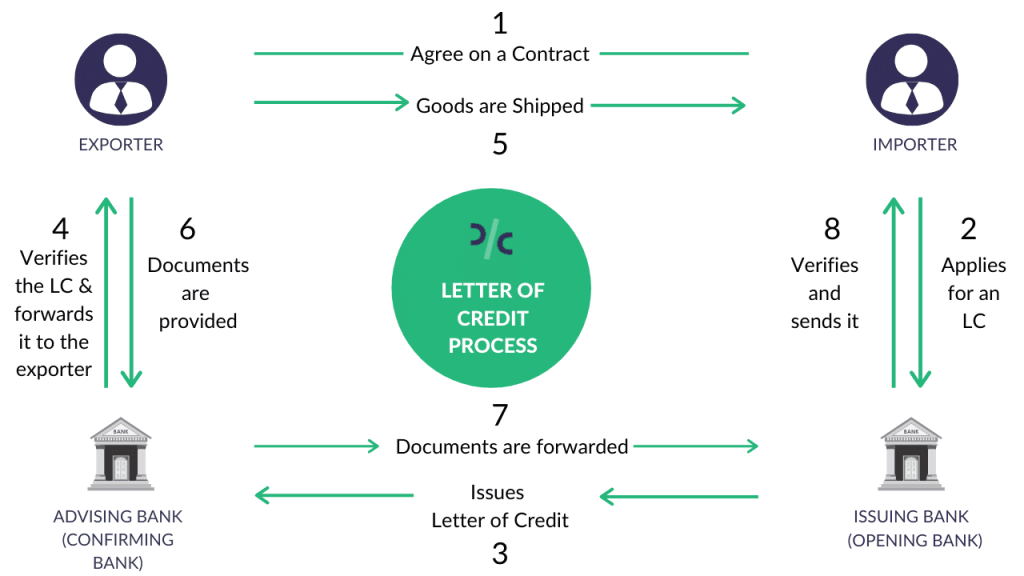
First, both parties agree in the sales contract that payment will be made via L/C. The importer then applies to their issuing bank to open the L/C in favor of the exporter.
The issuing bank sends the L/C to the exporter’s advising bank, which verifies authenticity and forwards it to the exporter. The exporter carefully reviews all terms including product description, quantity, shipment deadline, required documents, and payment terms.
After shipment, the exporter submits required documents such as Bill of Lading, Commercial Invoice, Packing List, Certificate of Origin, and Insurance Certificate. The bank checks whether the documents strictly comply with the L/C terms.
If compliant, payment is released either immediately (Sight L/C) or after a defined credit period (Usance L/C).
L/C vs T/T Comparison
Many importers compare L/C with standard bank transfer (T/T) before deciding.
| Criteria | Letter of Credit | T/T (Bank Transfer) |
|---|---|---|
| Security | Very High | Medium |
| Bank Involvement | Yes | No |
| Documentation | Strict | Flexible |
| Cost | Higher Bank Fees | Lower Cost |
| Suitable For | Large Orders | Small & Repeat Orders |
| Risk Protection | Strong | Limited |
L/C is generally recommended for high-value transactions, new supplier relationships, and complex industrial orders. T/T is more common for repeat orders and smaller businesses.
Is Letter of Credit Safe?
Yes, when properly managed. L/C offers bank-backed payment security and operates under international rules such as UCP 600. It significantly reduces fraud and payment default risk.
However, safety depends on correct documentation and professional coordination. Even small discrepancies in product description, shipment date, or documentation format can delay payment. For this reason, many global importers rely on experienced sourcing partners to manage compliance and communication with factories.
Ucsourcing supports international buyers with supplier negotiation, production monitoring, inspection coordination, documentation review, shipping arrangement, and private label packaging services. You can learn more at https://ucsourcing.com/our-services/
8 Common Types of Letter of Credit
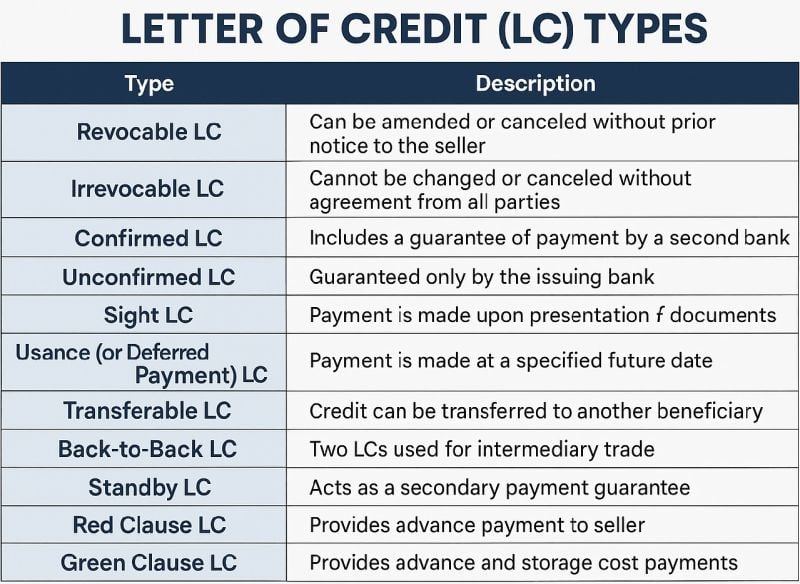
Sight L/C allows immediate payment upon compliant document presentation.
Usance L/C allows payment after a fixed credit period.
Revocable L/C can be amended without beneficiary consent and is rarely used today.
Irrevocable L/C cannot be changed without agreement of all parties and is the most common type.
Confirmed L/C adds a second bank guarantee.
Unconfirmed L/C relies only on the issuing bank.
Transferable L/C allows the beneficiary to transfer credit to another party.
Standby L/C functions as a payment guarantee in case of default.
Common Risks in L/C Transactions
Although secure, L/C transactions may face practical issues such as document discrepancies, shipment delays, insurance mismatch, incorrect HS codes, and amendment delays. These issues can cause payment refusal even if goods are correctly shipped.
Proper contract drafting, early document review, and coordination between factory and bank significantly reduce risk. If you are importing from China and need structured trade management, we can assist with end-to-end sourcing and documentation support.
Frequently Asked Questions
What is the minimum order value suitable for L/C?
L/C is typically recommended for orders above $30,000–$50,000 due to bank fees.
Is L/C better than T/T?
For large and new transactions, yes. For small repeat orders, T/T is often more efficient.
Can L/C protect against poor quality?
No. L/C protects document compliance. Quality inspection must be arranged separately.
How long does an L/C transaction take?
Usually 2–6 weeks depending on production and shipment schedules.
Who pays L/C bank charges?
Charges are negotiable and defined in the contract.
Can L/C terms be amended?
Yes, but amendments require approval from all parties and may delay shipment.
Is L/C common for eCommerce sellers?
Rarely. Most small online sellers use T/T due to smaller order sizes.
What happens if documents contain errors?
The issuing bank may reject payment unless the buyer accepts discrepancies.
Start Importing from China with Confidence
Choosing the right payment method is only one element of successful international trade. Supplier reliability, production monitoring, packaging compliance, and shipping coordination are equally important.
If you are planning to import from China and want professional support in sourcing, inspection, documentation, and logistics management, contact us today.
Website: https://ucsourcing.com/our-services/
Email: [email protected]
WhatsApp: +86-18026272594