South America is becoming a stronger market for electrical products, solar projects, construction materials, and industrial power systems. For importers, wholesalers, contractors, and project buyers, choosing the right cable is no longer just about price. It is about safety, certification, climate resistance, delivery reliability, and long-term performance.
In many South American markets, the fastest-moving cable products include American standard THHN/THW wire, PV1-F solar cable, low voltage power cable, EPR medium voltage cable, and RVV flexible cable. These products are popular because they match real local demand: construction wiring, solar installation, factory power systems, household appliances, temporary power use, and infrastructure projects.
Clean energy investment in Latin America and the Caribbean reached about USD 70 billion in 2025, and solar PV is expected to lead renewable energy expansion in the region, especially in Brazil, Mexico, and Chile. This is one reason solar cable demand continues to grow.
For buyers, the real question is simple: how do you choose a cable that sells well, passes local requirements, and does not create problems after shipment?
For more details, please inquire:https://ucsourcing.com/contact-us/
What Cable Types Are Selling Fast in South America?
South America is not a single market. Brazil, Colombia, Chile, Peru, Argentina, Ecuador, and other countries may have different project standards and import requirements. However, several cable categories are consistently in demand because they match the region’s most common applications.
THHN/THW Wire for Construction and Building Projects
THHN and THW wire are widely used for building wiring, commercial projects, electrical panels, branch circuits, and general low voltage electrical installations. Many South American buyers like American standard cable because it is familiar, easy to explain to contractors, and suitable for many building projects.
UL 83 covers 600 V single-conductor thermoplastic-insulated wires and cables used under electrical codes in the United States, Canada, and Mexico. For projects that request American standard wire, UL-related compliance can be an important selling point.
For THHN/THW cable, buyers usually care about conductor material, insulation thickness, nylon jacket quality, voltage rating, color options, reel length, and clear printing on the cable surface. A good cable should not only look clean on the reel but also perform consistently during installation.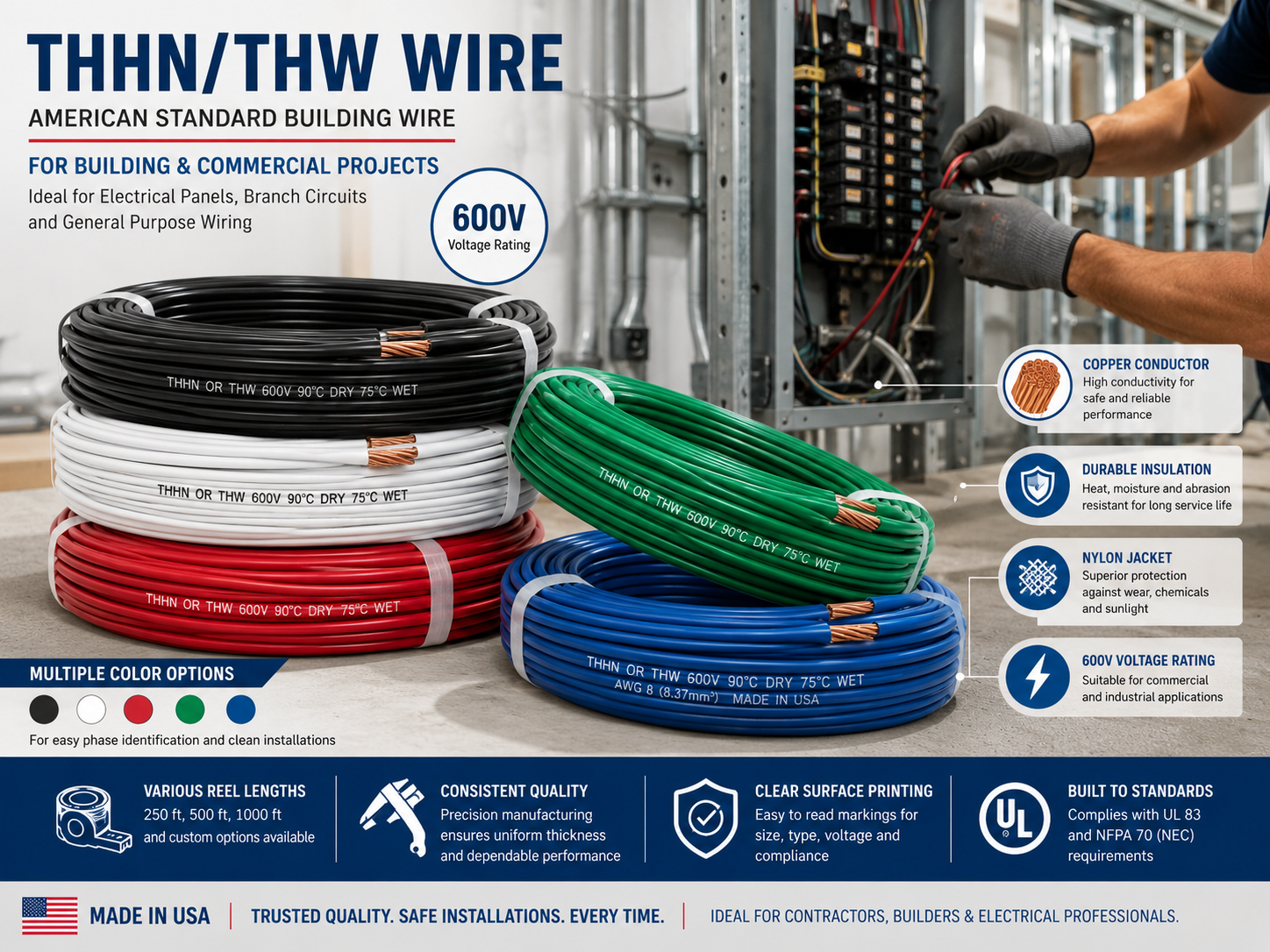
PV1-F Solar Cable for Solar Energy Projects
PV1-F solar cable remains a popular search term in many export markets. In newer projects, buyers may also ask for H1Z2Z2-K, EN 50618, IEC 62930, or TÜV-approved solar cable. These products are used for connecting solar panels, inverters, combiner boxes, and other DC-side photovoltaic systems.
IEC 62930 applies to photovoltaic cables used on the DC side of PV systems, with rated DC voltage up to 1.5 kV. The standard is designed for cables used under demanding climate conditions.
For South America, this matters a lot. Solar cable may be exposed to strong sunlight, high UV levels, coastal humidity, rain, dust, and temperature changes. Buyers should pay attention to UV resistance, weather resistance, heat resistance, insulation material, tinned copper conductor, and long-term outdoor durability.
Low Voltage Power Cable for Commercial and Industrial Use
Low voltage power cable is one of the most practical categories for South American buyers. It is used in buildings, factories, warehouses, machinery systems, distribution panels, and small infrastructure projects.
The key selling points are simple but important: stable conductor resistance, proper insulation thickness, clear voltage rating, flexible packaging options, and reliable factory testing. For many importers, this type of cable moves quickly because it can serve both project buyers and local distributors.
EPR Medium Voltage Cable for Utility and Infrastructure Projects
EPR medium voltage cable is often used in power distribution, industrial plants, substations, mining-related projects, and infrastructure systems. Compared with basic low voltage cable, medium voltage cable requires stronger technical control, better insulation performance, and more careful testing.
Buyers in this category are usually more professional. They will not only ask for price; they will ask for technical datasheets, test reports, production standards, conductor details, insulation material, shielding structure, and packing method.
RVV Flexible Cable for Appliances, Tools, and Light-Duty Power Use
RVV flexible cable is popular for household appliances, small machines, extension cords, lighting products, power tools, and general flexible connection use. It is easy to sell because it has broad applications and can be customized by core number, cross-section, color, length, and packaging.
For RVV cable, buyers usually want good flexibility, clean outer jacket, stable copper content, neat printing, and practical pricing. This is also a category where cable clamp, cable clips, and cable cutters may be purchased together as supporting products for installation or resale.
Why Do UV Resistance, Heat Resistance, and Humidity Resistance Matter?
South America has very different climates. Some regions have strong sun exposure, some have high humidity, some are coastal, and some have large temperature changes between day and night.
That means a cable that works well in a mild indoor environment may not perform the same way outdoors or in a hot, wet, or high-UV location.
For buyers, this creates a common cable crunch: the price looks good at first, but the cable may crack, fade, harden, or fail too early if the material is not suitable for the local climate.
A better cable for South America should focus on:
UV-resistant jacket for outdoor and solar use
Heat-resistant insulation for hot climates and electrical load safety
Moisture-resistant materials for humid or coastal areas
Clear cable marking for inspection and resale
Proper reel packing to prevent deformation during long-distance shipping
Accurate certificates and test reports for customs and project approval
This is why many professional buyers no longer ask only, “What is your best price?” They ask, “Can this cable survive our market?”
What Certifications Should Cable Buyers Check?
Certification is one of the biggest concerns for South American cable buyers. A low price is not enough if the product cannot pass import clearance, project inspection, or customer approval.
CE Certification
CE marking is mainly related to the European Economic Area. For electrical equipment within certain voltage limits, the EU Low Voltage Directive requires products to meet safety requirements before being placed on the EU market.
For South American buyers, CE can still be useful as an international quality reference, especially when selling to projects that also compare European standards. However, CE alone does not automatically replace local South American requirements.
UL, ETL, and American Standard Compliance
For THHN/THW and similar American standard cable, UL-related standards are often important. Some buyers prefer UL, ETL, or equivalent third-party testing because it helps prove that the cable follows recognized safety and performance requirements.
TÜV, IEC 62930, and EN 50618 for Solar Cable
For PV1-F and solar cable, buyers should pay close attention to TÜV approval, IEC 62930, EN 50618, and H1Z2Z2-K-related requirements. EN 50618 applies to low-smoke halogen-free flexible single-core power cables with cross-linked insulation and sheath for DC-side photovoltaic systems, and these cables are designed for long-term outdoor use under demanding climate conditions.
INMETRO for Brazil
Brazil is a key market in South America, and many electrical products require local conformity assessment. INMETRO Portaria No. 131 of March 23, 2022 covers quality and conformity assessment requirements for electrical wires, cables, and flexible cords.
For buyers shipping to Brazil, it is important to confirm whether the specific cable category needs INMETRO certification before production, not after the goods are finished.
RETIE for Colombia
Colombia’s RETIE is the technical regulatory framework for the electrical industry. It applies to manufacturers, importers, distributors, and installers of electrical products and systems.
For Colombian projects, RETIE can be a serious requirement. If the buyer imports cable without checking RETIE needs, the product may face approval delays or project rejection.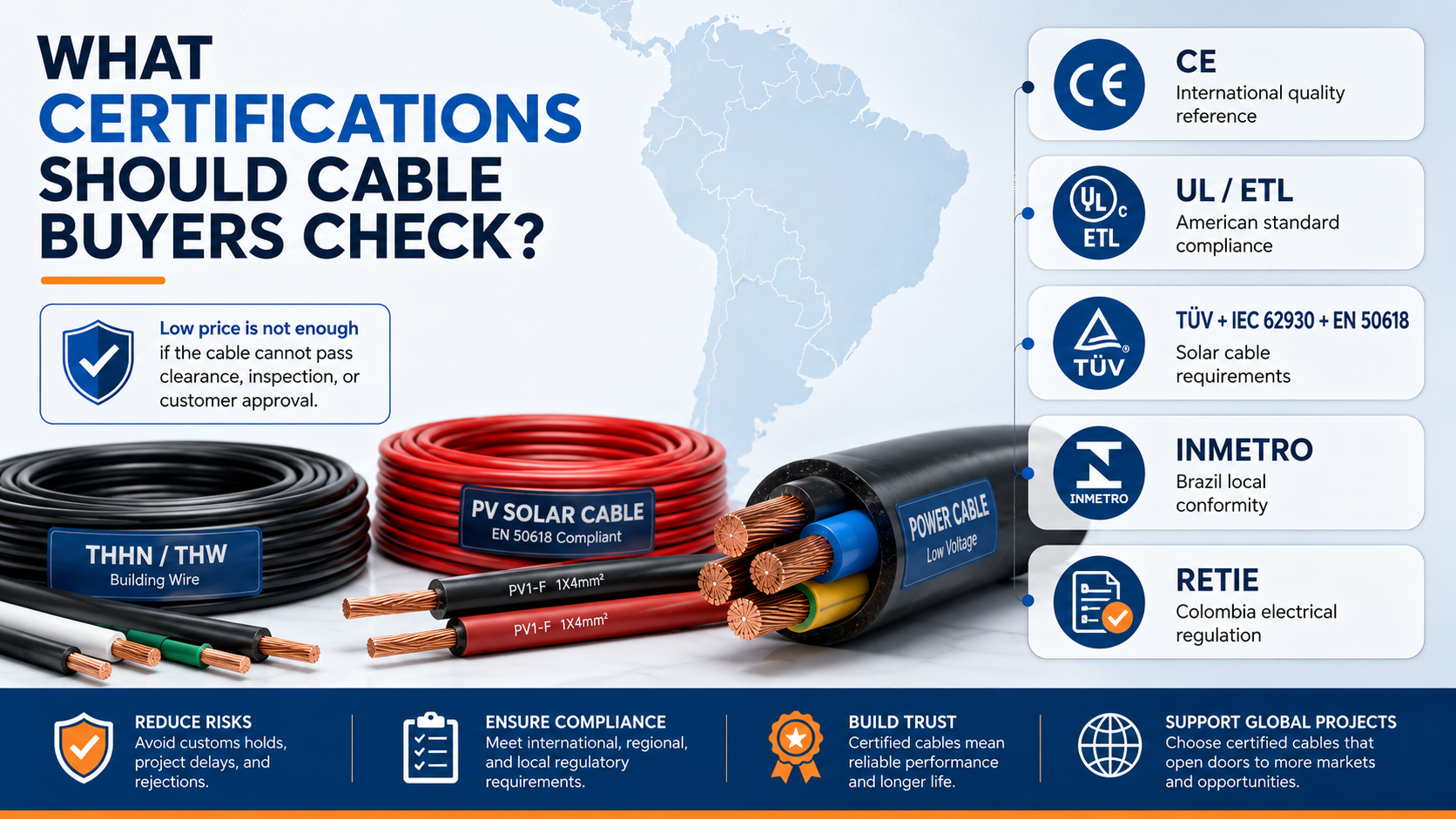
What Problems Do Buyers Often Face When Importing Cable?
Cable is heavy, technical, and specification-sensitive. Small mistakes can create expensive problems.
Shipping Problems
The most common shipping problems include wrong reel size, weak pallet packing, damaged drums, moisture during ocean freight, unclear shipping marks, mixed specifications, and incorrect documentation.
Cable is not a light product. Freight cost matters. If the supplier does not calculate weight, CBM, reel size, and loading plan properly, the buyer may face higher shipping costs than expected.
For example, a buyer may order several types of low voltage cable, PV1-F cable, and RVV cable in one shipment. If the factory packs them without clear marks, the buyer’s warehouse team may waste hours sorting the products after arrival. This does not sound like a big problem, but for distributors, slow receiving means slow sales.

Solving Transportation Issues:https://ucsourcing.com/shipping-solution/
Cable Quality Problems
Common cable quality issues include conductor resistance not matching the standard, short copper content, uneven insulation thickness, weak jacket material, poor flexibility, unclear printing, wrong color, wrong length per reel, and missing test reports.
A cable may look acceptable in photos, but that does not mean it will pass testing. This is why buyers should check samples, technical sheets, factory production ability, and pre-shipment inspection.
The “OMG Cable” Moment Buyers Actually Want
Every buyer wants that “omg cable” moment—but in a good way.
Not “OMG, the shipment is delayed again.”
Not “OMG, the cable marking is wrong.”
Not “OMG, the reel broke during unloading.”
The best reaction is: “OMG, this cable arrived exactly as ordered, with clean packing, correct labels, matching certificates, and stable quality.”
That is the kind of experience buyers remember. It also makes repeat orders much easier.
How Does UCSOURCING Help Buyers Source Cable from China?
UCSOURCING helps buyers source cable products from China with a more controlled process. Instead of only sending a random factory quotation, the work should start with the buyer’s real market needs.
For South American cable buyers, UCSOURCING can help check product specifications, compare suitable factories, confirm certification requirements, arrange samples, follow production, inspect packing, and coordinate shipping.
This is especially useful when the buyer needs multiple cable types in one order, such as THHN/THW wire, PV1-F solar cable, low voltage power cable, EPR medium voltage cable, RVV flexible cable, cable clamp, cable clips, and cable cutters.
The goal is not just to find a cheap cable. The goal is to find a cable that matches the market, passes the required checks, ships safely, and gives the buyer confidence to reorder.
Contact Us:https://ucsourcing.com/contact-us/
When Should You Choose Each Cable Type?
Choose THHN/THW cable when your market needs American standard building wire for construction, electrical panels, and commercial installation.
Choose PV1-F or H1Z2Z2-K solar cable when your customers are working on solar panels, rooftop solar, solar farms, or renewable energy systems.
Choose low voltage power cable when your buyers are contractors, wholesalers, factories, and distributors serving general power distribution needs.
Choose EPR medium voltage cable when the project involves utilities, substations, mining, industrial power, or infrastructure-level systems.
Choose RVV flexible cable when your customers need flexible wiring for appliances, lighting, tools, and smaller electrical products.
Choose cable clamp, cable clips, and cable cutters when you want to provide a more complete installation package or increase order value with related accessories.
Where Are These Cable Products Commonly Used?
In South America, cable products are commonly used in residential buildings, commercial construction, solar farms, warehouses, factories, mining areas, electrical panels, agricultural facilities, public infrastructure, and local hardware distribution channels.
The best-selling cable is usually not the one with the lowest price. It is the one that fits the local application, climate, certification, and installation habit.
That is why importers should think like their customers. A contractor wants easy installation. A distributor wants stable resale. A project buyer wants documents and compliance. A solar installer wants UV resistance and long outdoor life. A warehouse buyer wants clear packing and fast sorting.
When the cable meets these needs, it becomes easier to sell.
A Practical Example
A South American distributor plans to import cable for both construction and solar customers. At first, they only ask for the lowest price. After reviewing the market, they find that their customers care more about stable supply, correct standards, and outdoor durability.
Instead of buying one mixed low-cost cable order, they divide the order into three groups:
THHN/THW wire for building projects
PV1-F or H1Z2Z2-K solar cable for rooftop and solar farm customers
RVV flexible cable with cable clips and cable clamp accessories for small installers and hardware stores
Before production, the buyer confirms cable marking, reel length, conductor material, certificate needs, carton or drum packing, and shipping marks. Before shipment, the goods are checked again.
The final result is not just a lower-risk shipment. It is also easier for the distributor to sell each cable category to the right customer.
A Message from UCSOURCING
South America offers strong opportunities for cable importers, but buyers need to be careful. Fast-moving products such as THHN/THW wire, PV1-F solar cable, low voltage power cable, EPR medium voltage cable, and RVV flexible cable can sell well when the specifications, certifications, and packing are handled correctly.
The core selling points are clear: UV resistance, heat and humidity resistance, local certification support, reliable quality, and competitive pricing.
For buyers, the safest approach is not chasing the cheapest cable. It is choosing the right cable for the right market, with the right documents and the right sourcing process.
With a reliable sourcing partner like UCSOURCING, buyers can reduce guesswork, avoid common cable crunch problems, and build a more stable supply chain from China to South America.
More:https://ucsourcing.com/our-blog/
Contact UCSOURCING
If you need to source from China, our team can assist you with everything from supplier selection to final delivery.
Website Links:https://ucsourcing.com/
WhatsApp: +86-18026272594 name:Jenny
E-Mail: [email protected]
[email protected]
We help global buyers source smarter, reduce risks, and build stable supply chains in China