
Latex condoms are not ordinary disposable products. They are personal health products and, in many markets, regulated medical devices. For buyers, importers, private label brands, pharmacies, distributors, and e-commerce sellers, choosing latex condoms is not only about price, packaging, or product appearance. It is about safety, compliance, shelf life, factory control, leakage testing, electronic testing, lubricant compatibility, and destination-market registration.
In the U.S., condoms are classified as Class II medical devices under 21 CFR 884.5300, including condoms made from natural rubber latex, synthetic materials, or natural membrane materials. FDA guidance also requires latex condom labeling to address safety and effectiveness concerns, including proper use, allergy warnings, and expiration dating.
For buyers sourcing in China, working with the right sourcing supplier matters. A professional china sourcing agent should not only help you find a factory, but also help you check documents, review test reports, confirm packaging details, arrange samples, monitor production, and reduce compliance risk before shipment. That is where UCSOURCING can support importers who want a safer and more structured way to source latex condoms from China.
Talk to a Sourcing Expert:https://ucsourcing.com/contact-us/
What Are Latex Condoms?
Latex condoms are male external condoms made from natural rubber latex. They are designed to act as a barrier to help reduce the risk of pregnancy and sexually transmitted infections when used correctly and consistently. CDC states that latex condoms provide an effective barrier against even small STD pathogens in laboratory studies, but they must be used correctly and consistently to provide the best protection.
From a buyer’s point of view, latex condoms are popular because they are flexible, cost-effective, widely available, and supported by mature manufacturing standards. However, they also require strict quality control. A low-cost latex condom without verified testing, stable shelf-life data, proper packaging, and destination-market compliance can create serious legal, health, and brand risks.
What Industry Standards Should Buyers Check?
ISO 4074 for Natural Rubber Latex Male Condoms
For natural rubber latex male condoms, ISO 4074 is the key international standard for requirements and test methods. The ISO page lists ISO 4074:2015 as withdrawn and replaced by ISO 4074:2026, so buyers should always confirm which version their destination market, regulator, or customer requires.
ISO 4074 covers technical requirements and testing methods related to natural rubber latex condoms. In practical sourcing, buyers should ask factories for documents related to dimensions, burst volume and pressure, freedom from holes, packaging integrity, shelf-life stability, labeling, and lot testing.
ASTM D3492 for the U.S. Market
For the U.S. market, ASTM D3492 is an important standard specification for rubber contraceptives, meaning male condoms made from natural rubber latex. FDA’s recognized standards database lists ASTM D3492-16 as a recognized consensus standard, and ASTM describes the standard as covering individually packaged male condoms made from natural rubber latex for single use.
ASTM D3492 includes areas such as sampling, dimensions, tensile properties, air burst properties, leakage, package integrity, labeling, and storage. For serious importers, these are not “extra details.” They are the foundation of product safety and market acceptance.
ISO 23409 for Non Latex Condoms
Non latex condoms, including condoms made from synthetic materials, are not judged exactly the same way as natural latex condoms. FDA’s recognized standards database lists ISO 23409 as the standard for male condoms made from synthetic materials or blends of synthetic materials and natural rubber latex.
This matters when comparing latex and non latex condom options. Buyers cannot simply use the same factory documents, same claims, and same compliance assumptions for all materials.
ISO 16038 for Quality Management Guidance
ISO 16038 provides guidance on using ISO 4074 and ISO 23409 in the quality management of condoms. It focuses on quality issues during development, manufacturing, quality verification, and procurement.
For buyers, this is especially useful because condom sourcing is not only about finding a factory. It is about building a controlled procurement process.
GB/T 7544-2019 for China
In China, GB/T 7544-2019 is the national standard for natural rubber latex male condoms, with requirements and test methods. Buyers sourcing from Chinese factories should ask suppliers whether their production and testing documents align with GB/T 7544-2019 and with the destination-market requirements.
What Materials Are Available in the Condom Market?
Natural Rubber Latex Condoms
Natural rubber latex condoms are the most common option. They are elastic, widely accepted, and cost-efficient for mass-market retail. They are suitable for many buyers who need standard, thin, ultra-thin, textured, lubricated, flavored, colored, or private label condom products.
The main concern is latex allergy. FDA labeling rules require latex products that contact humans to carry a natural rubber latex allergy warning.
Polyurethane Condoms
Polyurethane condoms are a common non latex condom option. They are usually thinner and do not contain natural rubber latex proteins. They may be chosen by users with latex sensitivity. However, buyers must confirm testing standards, packaging claims, lubricant compatibility, shelf life, and local registration requirements.
Polyisoprene Condoms
Polyisoprene is a synthetic rubber material. It is often marketed as a softer non latex option with a more flexible feel than polyurethane. For buyers, the key point is not only material comfort, but whether the factory has stable production, reliable testing, and valid documents for that specific material.
Nitrile Internal Condoms
Nitrile is commonly used for internal condoms. CDC describes internal condoms as a thin pouch made of nitrile and states that HIV cannot travel through the nitrile barrier.
This product category may involve different design, packaging, instructions, and regulatory pathways compared with male external latex condoms.
Natural Membrane or Lambskin Condoms
Natural membrane condoms, often called lambskin condoms, are different from latex and synthetic condoms. CDC states that natural membrane condoms have small holes and should not be used to prevent HIV or other STIs.
For buyers, this means product claims must be handled very carefully. A supplier should never market natural membrane condoms the same way as latex or synthetic condoms for STI prevention.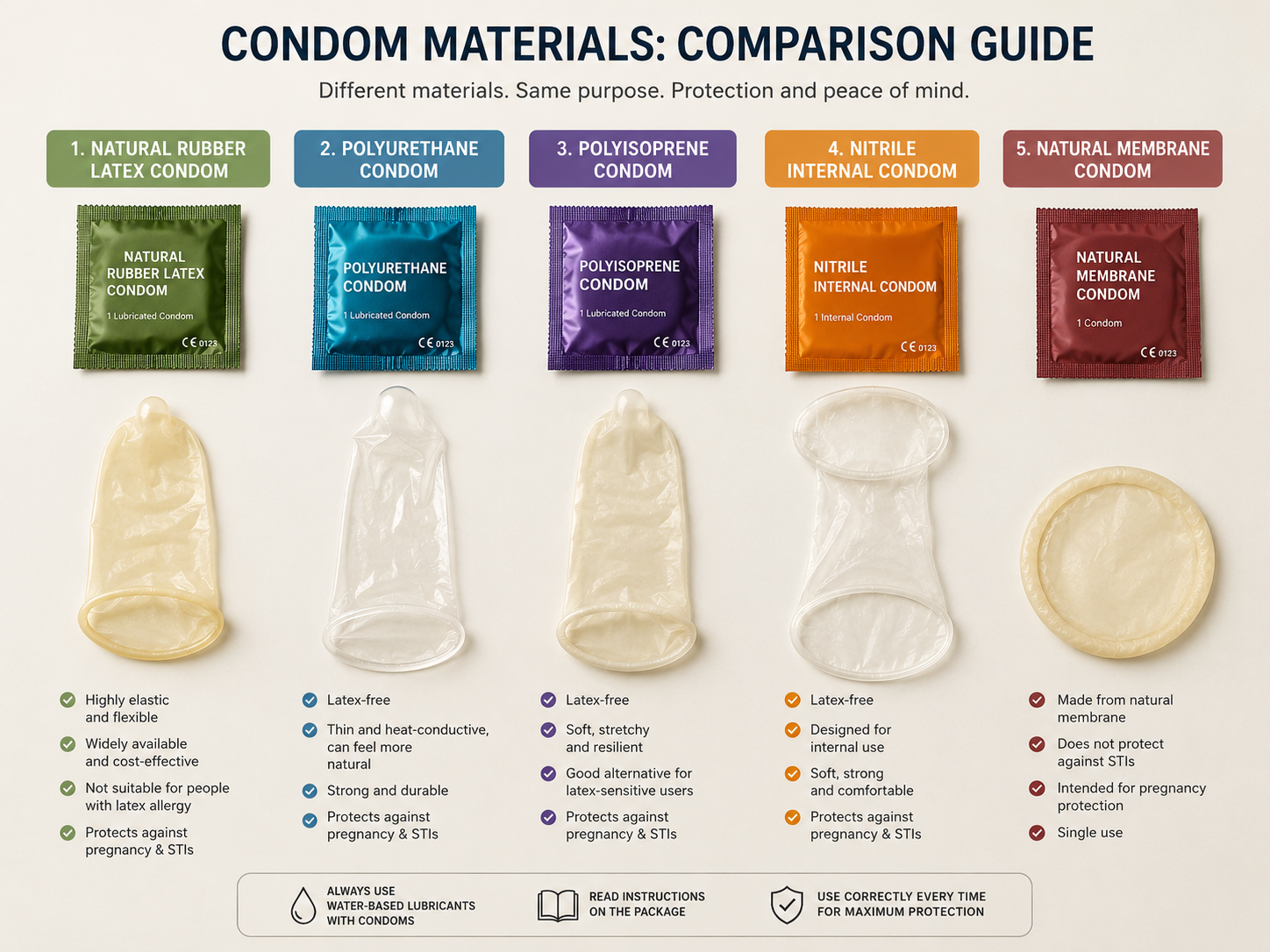
What Condom Sizes Should Buyers Offer?
Condom sizes are one of the most common real-world problems in this category. If a condom is too tight, users may feel discomfort and the condom may be more likely to break. If it is too loose, it may slip. CDC notes that condoms can break, slip, or leak when used incorrectly or inconsistently.
For B2B buyers, condom sizes should not be selected only by names like “regular,” “large,” or “XL.” Different brands may use size names differently. Buyers should check the nominal width, length, thickness, shape, reservoir tip design, and packaging claims.
A practical product range may include:
| Size Type | Common Market Positioning | Buyer Notes |
|---|---|---|
| Snug / Close Fit | For users who find regular condoms too loose | Good for brands focused on better fit and reduced slippage |
| Regular / Standard | Most common retail option | Suitable for mass market, pharmacies, and convenience retail |
| Large | For users who find standard condoms too tight | Must verify dimensions and packaging claims |
| XL / Custom Fit | For more specific fit needs | Requires stronger technical documentation and clear labeling |
When sourcing condom sizes, ask the factory for a technical specification sheet showing nominal width, length, thickness, shape, lubricant amount, packaging material, and tolerance range. For private label projects, UCSOURCING can help buyers compare supplier specifications instead of relying only on catalog photos.
Learn About Us:https://ucsourcing.com/our-services/
What Is the Difference Between Latex and Non Latex Condoms?
The difference between latex and non latex condoms is mainly material, user experience, allergy risk, cost, and compliance route.
Latex condoms are usually more elastic and cost-efficient. They are widely used, widely tested, and supported by mature standards such as ISO 4074 and ASTM D3492. Non latex condoms, including polyurethane and polyisoprene options, are important for users with latex sensitivity and for brands that want to offer allergy-friendly alternatives.
However, non latex condoms are not automatically “better.” They may cost more, require different testing, and need different regulatory documentation. For buyers comparing latex and non latex condom options, the right question is not “Which one is cheaper?” The right question is: “Which material fits my market, my claims, my compliance requirements, and my users?”
How to Put on a Condom Correctly?
For brands and importers, user instructions are part of product responsibility. Clear instructions reduce misuse and support safer use.
CDC guidance for external condoms includes carefully opening the wrapper, placing the condom on the tip of the penis before sex, pinching air out of the tip, unrolling it all the way down, holding the base before withdrawal, and throwing it away after use. CDC also says not to reuse condoms, not to use more than one condom at a time, and not to use oil-based products with latex condoms because they can weaken latex and cause breakage.
For buyers, this means the instruction leaflet, retail box, individual foil marking, warning language, and translation quality must be reviewed before mass production. Poor instructions can become a compliance and liability issue.
Will Condoms Expire?
Yes. Condoms expire. For latex condoms in the U.S., FDA guidance says the retail package and individual foil packet must include an expiration date no later than five years from the date of product packaging, and that date must be supported by shelf-life data from the manufacturer.
Shelf life is not just a printed date. It must be supported by real stability testing, accelerated aging where applicable, packaging integrity data, and production control. WHO/UNFPA guidance also emphasizes the use of accredited laboratories and current ISO 4074 test methods for male latex condom testing.
For importers, this means you should check:
- manufacturing date
- expiration date
- shelf-life test report
- storage conditions
- foil packaging integrity
- carton marking
- batch number and traceability
- destination-country labeling language
Never buy latex condoms only because the price is low. A short remaining shelf life can make the product hard to sell, hard to register, or risky to distribute.
How Can Buyers Identify a Reliable Latex Condom Supplier?
A reliable latex condom supplier should be able to provide more than a quotation. Buyers should request:
- business license and medical device-related qualifications
- ISO 4074 or related test reports
- ASTM D3492-related documents for U.S.-focused projects
- GB/T 7544-2019 documents for China production reference
- electronic testing records
- water leakage or freedom-from-holes testing
- air burst testing
- package integrity testing
- shelf-life and stability data
- lubricant compatibility information
- material safety and biocompatibility documents
- destination-market registration support
If a supplier avoids technical questions, only sends product pictures, or says “many customers buy this, no problem,” that is not enough for this category.
What Common Mistakes Should Buyers Avoid?
The first mistake is comparing only unit price. Latex condoms are high-risk products. A tiny quality issue can become a major health, legal, and brand problem.
The second mistake is assuming that all condom factories are the same. Some factories may be strong in standard latex condoms but weak in non latex condoms, private label packaging, export documentation, or destination-market registration.
The third mistake is ignoring packaging. For condoms, packaging is part of product safety. Poor foil sealing, weak cartons, missing batch numbers, incorrect expiration dates, and unclear instructions can all create risk.
The fourth mistake is not checking lubricant compatibility. For latex condoms, oil-based products can weaken latex and cause breakage, according to CDC.
The fifth mistake is treating “medical device compliance” as something to check after production. Compliance should be reviewed before sampling, before artwork confirmation, and before the purchase order is placed.
Why the Lowest Price Was Not the Best Option
A private label buyer wanted to launch latex condoms for online retail and pharmacy distribution. At first, the buyer focused mainly on price, packaging design, and MOQ. One supplier offered a very low unit price and fast delivery, but the documents were incomplete. The supplier could not provide clear shelf-life data, complete leakage testing records, or strong packaging integrity information.
After reviewing the project, the buyer changed the selection process. Instead of asking only for price, the buyer requested technical specifications, ISO 4074-related testing, batch traceability, lubricant information, expiration-date support, and packaging samples. The cheaper supplier was removed from the shortlist.
The final supplier had a higher unit price, but offered better testing support, clearer documentation, more stable packaging, and stronger export communication. In this category, that was the safer business decision. For medical and personal health products, a slightly lower price is not a real saving if it increases the risk of recalls, complaints, customs issues, or brand damage.
This is the type of sourcing process UCSOURCING helps buyers manage. We help compare suppliers, check documents, confirm samples, follow production, arrange quality inspection, and coordinate shipping, so buyers do not have to rely on factory promises alone.
Where Can UCSOURCING Help?
For buyers who want to understand how to import from China safely, UCSOURCING can support the full sourcing process for latex condoms and related personal health products. Our role is not to make medical claims. Our role is to help buyers build a safer sourcing path.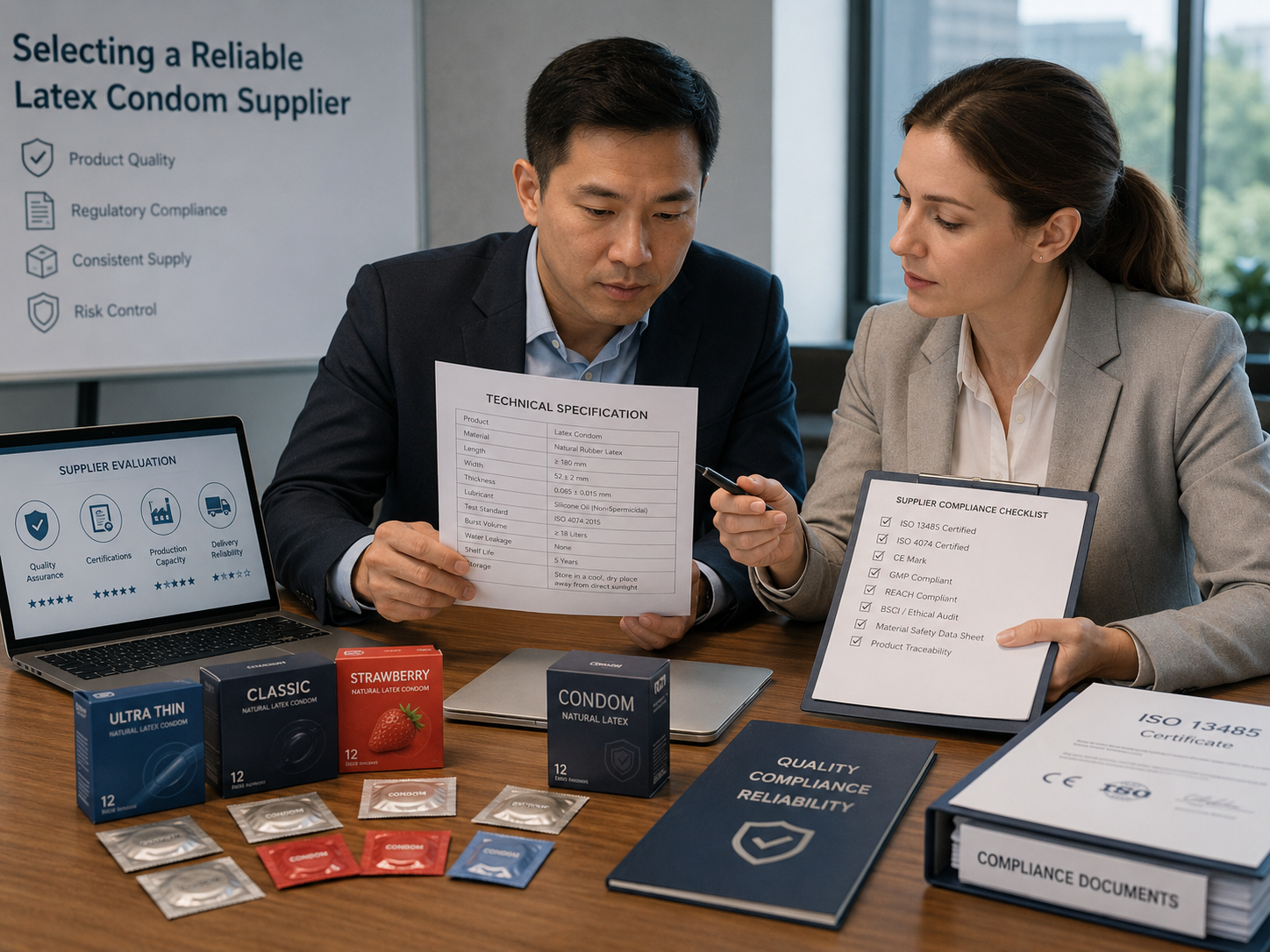
We can help with:
- sourcing in China for qualified factories
- supplier screening and document review
- sample coordination
- quotation comparison
- packaging and private label communication
- production follow-up
- pre-shipment inspection
- compliance document collection
- logistics coordination
If you are looking for a sourcing agent china partner who understands that latex condoms are not ordinary consumer goods, UCSOURCING can help you reduce risk before you place a large order.
Latex condoms may look simple, but sourcing them is not simple. Buyers must consider material, condom sizes, non latex condoms, latex and non latex condom differences, shelf life, packaging, lubricant compatibility, standards, testing, factory qualifications, and destination-market registration.
The safest buying decision is not always the lowest price. The safest decision is choosing a supplier and sourcing process that can support real compliance, stable quality, clear documents, and long-term brand protection.
For importers, distributors, private label brands, and e-commerce sellers, latex condom sourcing should always start with one question: “Can this supplier prove the product is safe, compliant, and suitable for my market?”
That question is where better sourcing begins.
If you are planning a latex product order and are not sure which material, standard, or factory type is right for your market, contact UCSOURCING to start with a safer sourcing plan.
Send us your product details, and we will help you find a more reliable way to source from China.
Read More Sourcing Guides:https://ucsourcing.com/our-blog/