A lead acid battery is still one of the most widely used power backup solutions for UPS systems, telecom stations, emergency lighting, power plants, railway systems, solar power stations, wind power stations, switchgear, control systems, radio stations, and broadcasting equipment.
For industrial buyers, the key question is not only price. The real question is: how do you choose a sealed lead acid battery that is safe, long-lasting, easy to maintain, and suitable for international projects?
Many buyers search terms like battery lead acid battery, batteries lead acid sealed, sealed lead acid battery, lead acid battery charger, or agm battery vs lead acid because they want to understand which battery type is right for their application. This guide explains the structure, safety features, charging requirements, application fields, buying concerns, and sourcing solutions for sealed lead acid batteries.
UCSOURCING helps international buyers source battery products from China by checking supplier capability, product specifications, certifications, packing methods, charger compatibility, and shipment arrangements before mass production.
Seeking Help:https://ucsourcing.com/contact-us/
What Is a Sealed Lead Acid Battery?
A sealed lead acid battery is a rechargeable battery designed to store and release electrical energy through a lead-acid chemical system. Compared with traditional flooded batteries, many sealed lead acid battery models are designed to reduce maintenance work, limit acid leakage risk, and provide stable backup power in fixed installations.
In many projects, sealed lead acid batteries are used where power failure cannot be accepted. For example, a UPS system needs immediate backup power when the grid fails. A telecom base station needs stable energy support to keep communication running. Emergency lighting systems need reliable battery power during power outages.
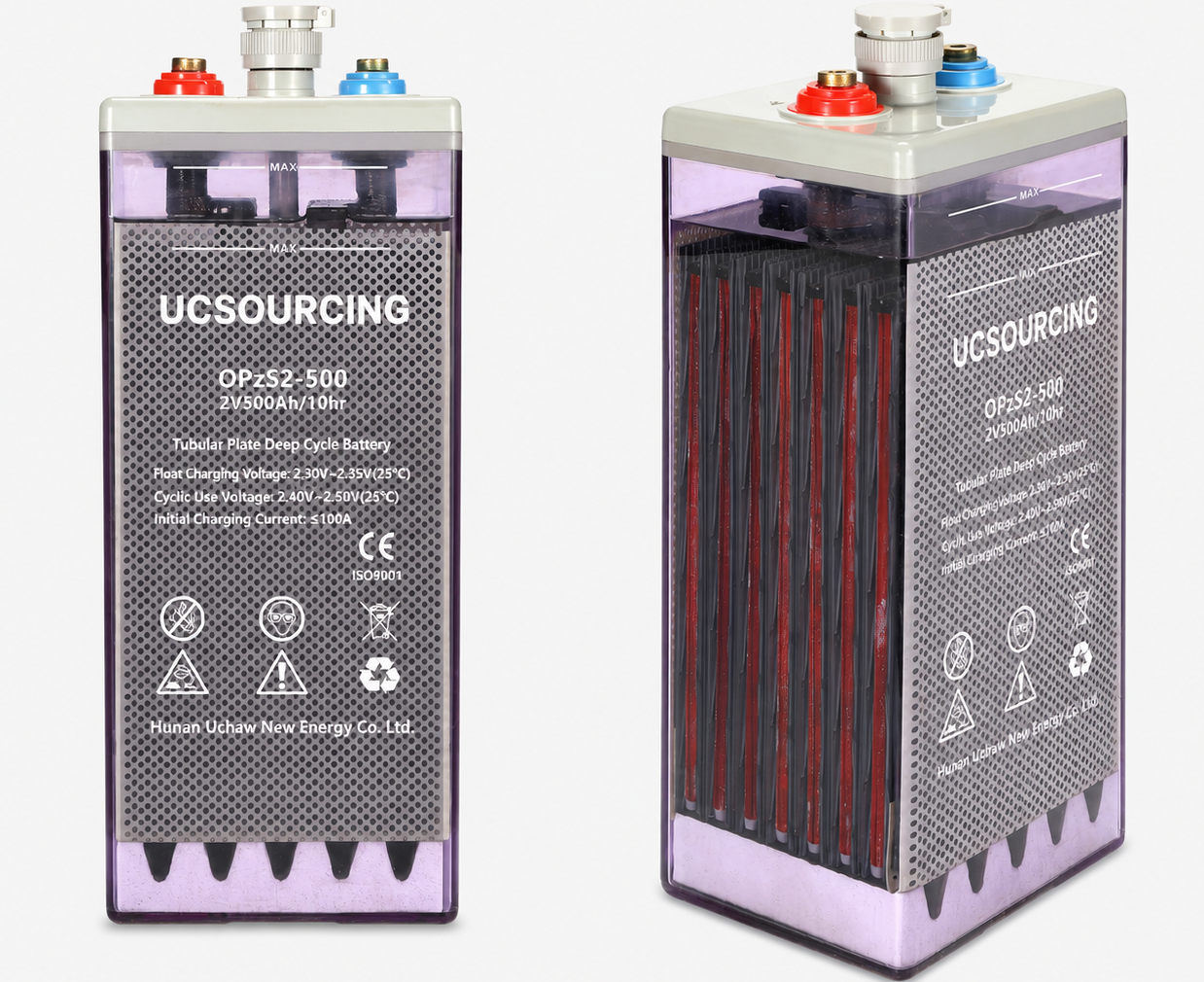
A quality sealed lead acid battery should offer stable discharge performance, safe structure, strong terminal design, good sealing performance, and reliable float charging ability.

How Does a Long-Life Lead Acid Battery Improve System Reliability?
For stationary backup applications, battery life matters more than short-term cost. A lower-quality lead acid battery may look cheaper at the beginning, but early failure can cause power interruption, maintenance cost, replacement cost, and project risk.
Some high-performance lead acid battery models are designed for a float service life of up to 20 years at 25°C. This type of design is especially useful for power systems, telecom systems, UPS systems, and other backup power environments where batteries stay on standby charge for a long time.
Key design features may include:
Tubular Positive Plate Structure
A tubular positive plate structure helps improve active material retention and deep discharge performance. This design is often used in long-life industrial batteries where durability and stable capacity are important.
PVC Porous Corrugated Separator and Microporous Rubber Separator
The combination of PVC porous corrugated separators and microporous rubber separators helps support internal stability, electrolyte movement, and separation between positive and negative plates.
Acid-Resistant and Explosion-Resistant Design
For lead acid battery products, safety is always a key buying point. Acid resistance helps reduce corrosion risk, while an explosion-resistant structure helps improve safety in demanding installations.
SAN Transparent Container
A SAN transparent case allows users to observe the internal condition of the battery more clearly. This is useful for maintenance checking, acid level observation, and visual inspection.
Labyrinth Sealing Structure
A unique labyrinth sealing structure helps reduce acid mist movement and helps prevent acid corrosion around battery terminals during use.
Embedded Copper Core and Flexible Copper Cable Connection
An embedded copper core structure, combined with flexible copper cable connection and external insulation, helps improve current conduction, safety, and connection reliability.
These details are important because industrial battery buyers are not only buying capacity. They are buying safety, service life, installation reliability, and long-term system stability.
How Should a Lead Acid Battery Charger Be Chosen Safely?
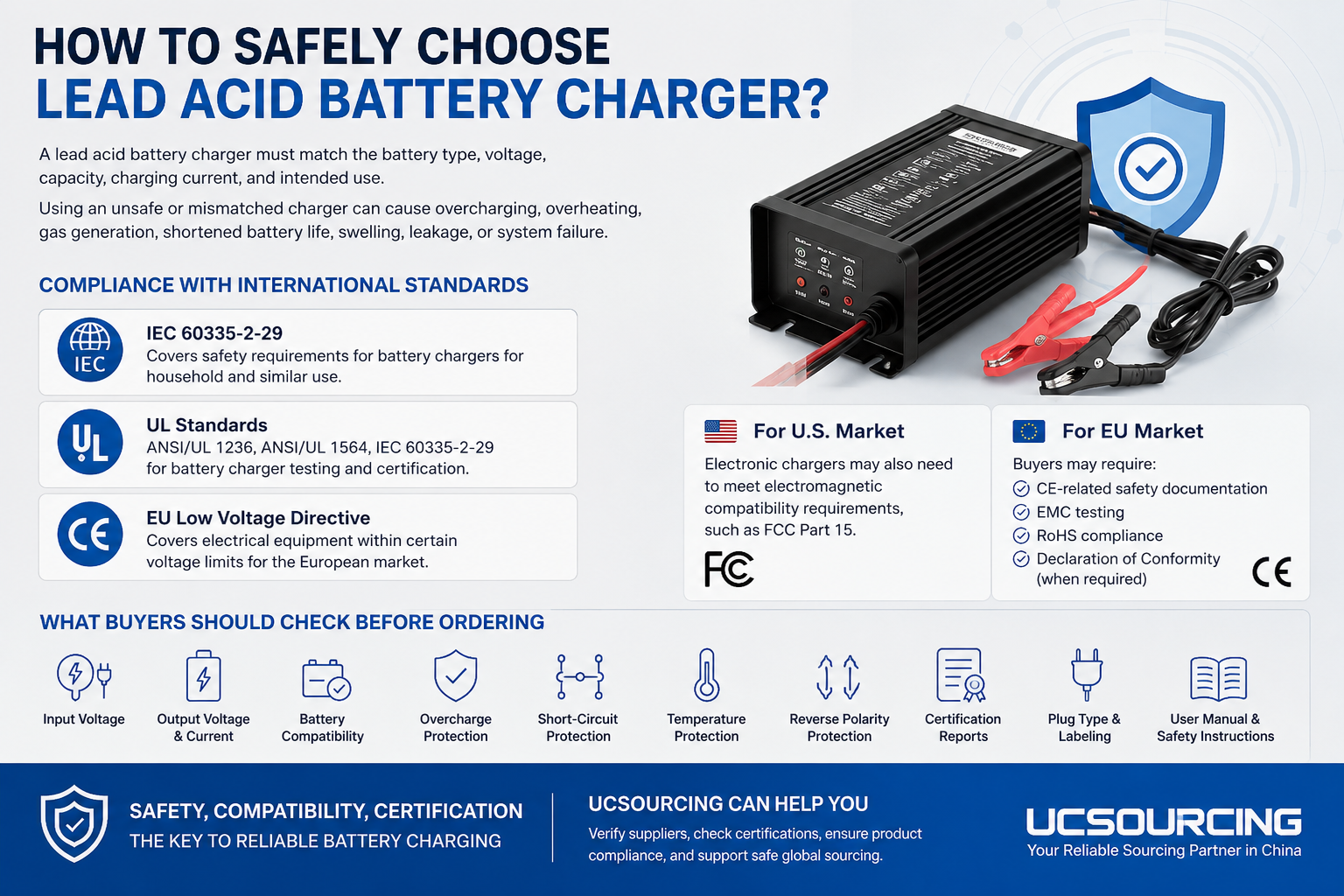
A lead acid battery charger must match the battery type, voltage, capacity, charging current, and intended use. An unsafe or mismatched lead acid battery charger can cause overcharging, heat, gas generation, shortened battery life, swelling, leakage, or system failure.
For international markets, battery chargers may need to comply with different safety and electrical standards depending on the destination country and product type. For example, IEC 60335-2-29 covers safety requirements for electric battery chargers for household and similar use, while UL lists charger-related standards such as ANSI/UL 1236, ANSI/UL 1564, and IEC 60335-2-29 for battery charger testing and certification. The EU Low Voltage Directive also covers electrical equipment within certain voltage limits for the European market.
For the U.S. market, electronic chargers may also need to consider electromagnetic compatibility requirements, such as FCC Part 15 where applicable. For the EU market, buyers may also need CE-related safety documentation, EMC testing, RoHS compliance for electrical and electronic equipment, and a proper Declaration of Conformity when required.
What Should Buyers Check Before Ordering a Lead Acid Battery Charger?
Buyers should check:
- Input voltage, such as 110V, 220V, or wide-range input
- Output voltage and charging current
- Compatibility with sealed lead acid battery, AGM battery, gel battery, or flooded battery
- Overcharge protection
- Short-circuit protection
- Temperature protection
- Reverse polarity protection
- Certification reports for the target market
- Plug type and labeling requirements
- User manual and safety instructions
UCSOURCING can help buyers verify whether the charger supplier can provide real test reports, correct labels, proper packaging, and market-specific documentation before shipment.
Contact Us:https://ucsourcing.com/our-services/
What Is the Difference: AGM Battery vs Lead Acid?
Many buyers search agm battery vs lead acid because they are not sure whether AGM is a different battery chemistry. In simple terms, AGM is one type of lead acid battery. AGM stands for Absorbent Glass Mat. It uses glass mat separators to absorb and hold the electrolyte.
AGM Battery
An AGM battery is usually sealed, maintenance-reduced, and suitable for UPS systems, emergency power, alarm systems, telecom equipment, mobility equipment, and backup applications. It has better spill resistance than traditional flooded batteries and is easier to install in many indoor or equipment-based environments.
Traditional Flooded Lead Acid Battery
A flooded lead acid battery usually contains liquid electrolyte and may need more maintenance, such as checking electrolyte level and ventilation conditions. It can be cost-effective for some industrial and energy storage applications, but handling and shipping can be more complicated.
Which One Should You Choose?
If your project needs lower maintenance, cleaner installation, and safer handling, an AGM sealed lead acid battery may be a better choice. If your project is cost-sensitive and has trained maintenance staff, a flooded lead acid battery may still be suitable.
The best choice depends on application, cycle life requirement, float life requirement, installation environment, charging method, budget, and local regulations.
Where Are Sealed Lead Acid Batteries Commonly Used?
Sealed lead acid batteries are used in many industrial and backup power systems, including:
Power Systems
Lead acid batteries are widely used in power stations, substations, and DC backup systems to support control, protection, and emergency operation.
Emergency Lighting Systems
Emergency lighting requires stable backup power when normal power fails. A sealed lead acid battery is often selected for emergency lamps, exit lights, and building safety systems.
Communication Systems
Telecom base stations, network cabinets, data communication systems, and signal equipment often use sealed lead acid batteries for backup power.
Railway Systems
Railway signaling, communication, switching, and control equipment require stable backup energy. Battery reliability is critical because downtime can affect safety and operation.
Solar Power Stations
Solar systems may use lead acid batteries for energy storage, especially in off-grid or backup applications.
UPS Systems
A UPS system uses batteries to provide instant backup power for computers, servers, data centers, medical equipment, industrial controls, and other critical loads.
Wind Power Stations
Wind power projects may use batteries for control systems, backup circuits, and energy storage support.
Switchgear and Control Systems
Switching and control systems need stable DC power to ensure safe operation during grid instability or outage.
Radio Stations and Broadcasting Stations
Broadcasting equipment needs continuous power. A sealed lead acid battery can help keep transmission and communication equipment running during emergencies.
IEC 62485-2 applies to stationary secondary batteries and installations up to DC 1500V and describes protection measures against hazards from electricity, gas emission, and electrolyte. It also lists telecommunications, power station operation, emergency lighting, UPS, engine starting, and photovoltaic systems as example applications.
When Should Buyers Consider a Transparent Lead Acid Battery?
A transparent lead acid battery is useful when buyers want easier visual inspection and safer shipping preparation. One special design is a dry-charged transparent lead acid battery that can be shipped without acid inside and filled with acid after arrival.
This design has several advantages:
The Battery Can Be Shipped Dry Before Activation
During transportation, the battery is dry inside, so the internal chemical reaction is not active in the same way as a filled battery. This helps reduce possible leakage, corrosion, and acid-related transportation risk.
Acid Can Be Added After Arrival
After the goods arrive at the destination, the buyer or local technician can add acid according to the correct procedure and activate the battery before use.
Transparent Shell Helps Observation
The transparent case allows users to observe the internal battery condition, including acid level and plate condition. This can make inspection and maintenance easier.
Better for Some Long-Distance Export Projects
For some export projects, especially where buyers worry about acid leakage during sea shipping or inland transportation, a transparent dry-charged lead acid battery can be a practical option.
However, battery transportation is still regulated in many countries. Wet batteries filled with acid and non-spillable wet batteries may fall under dangerous goods classifications such as UN2794 or UN2800, depending on the product and shipping condition. Buyers should confirm classification, packing, labeling, and documentation before shipment.
UCSOURCING can help buyers communicate with suppliers, confirm whether the battery is shipped dry or filled, check packing requirements, and coordinate freight solutions based on destination requirements.
Learn More:https://ucsourcing.com/contact-us/
What Questions Do Buyers Usually Ask Before Buying Lead Acid Batteries?
1. How do I know which lead acid battery is suitable for my project?
You need to confirm voltage, capacity, battery type, cycle life, float life, discharge time, installation environment, charging method, and application. A battery for UPS backup may not be the same as a battery for solar storage or railway equipment.
2. Can I use any lead acid battery charger?
No. The lead acid battery charger must match the battery type and charging profile. A wrong charger may damage the battery or create safety risks.
3. What certifications should I ask for?
It depends on your market. Common requests may include IEC-related test standards, UL-related standards for the U.S. market, CE documentation for Europe, RoHS for chargers or electrical products, MSDS/SDS, UN38.3 if lithium batteries are involved, and transport-related documents for lead acid batteries. For lead acid batteries, the exact documentation depends on whether the battery is sealed, non-spillable, flooded, dry-charged, or filled with acid.
4. Is AGM better than normal lead acid?
AGM is a type of lead acid battery. It is usually better for low-maintenance backup applications, but it may cost more than some flooded batteries. The right choice depends on use case.
5. Can the battery be customized?
Yes, many suppliers can customize voltage, capacity, terminal type, case color, label, carton, pallet, cable, connector, and packaging. For larger projects, technical confirmation should be done before mass production.
6. How can I avoid poor-quality batteries?
Check factory experience, production process, plate quality, separator material, case material, terminal structure, capacity test, internal resistance test, charge-discharge test, sample performance, and inspection reports.
7. How should batteries be packed for export?
Packaging should protect the battery from short circuit, impact, leakage, terminal damage, and carton breakage. Palletizing, insulation protection, warning labels, and correct shipping documents may be required.
8. Can UCSOURCING help source batteries and chargers together?
Yes. UCSOURCING can help match sealed lead acid battery suppliers with compatible lead acid battery charger suppliers, compare quotations, check documents, arrange samples, follow production, inspect packing, and support shipping coordination.

How Can UCSOURCING Help Buyers Source Lead Acid Batteries from China?
Sourcing lead acid batteries is not the same as buying simple consumer products. Batteries involve technical specifications, safety requirements, charger compatibility, chemical materials, packing risks, and market compliance.
UCSOURCING helps buyers with:
- Supplier search and factory screening
- Battery specification comparison
- Sealed lead acid battery and charger matching
- AGM battery vs lead acid product selection
- Sample checking
- Packaging review
- Certification and document collection
- Quality inspection before shipment
- Freight and export coordination
- Communication with Chinese factories
For buyers who need long-life batteries, transparent dry-charged batteries, UPS batteries, telecom batteries, solar batteries, or industrial backup batteries, UCSOURCING can help reduce sourcing risk and make the purchasing process easier to manage.
What Makes a Lead Acid Battery Safe and Reliable?
A reliable lead acid battery should not only have enough capacity. It should also have a safe internal structure, stable float life, proper sealing design, strong terminals, compatible charger support, clear documentation, and export-ready packing.
For industrial buyers, safety should come before price. The battery, charger, packaging, and shipping method must work together. A low-cost battery with poor charging safety or weak export packing can create bigger losses later.
If you are sourcing sealed lead acid batteries, AGM batteries, transparent lead acid batteries, or lead acid battery chargers from China, UCSOURCING can help you find suitable suppliers, verify important details, and manage the process from quotation to shipment.
More:https://ucsourcing.com/our-blog/
Contact UCSOURCING
If you need to source from China, our team can assist you with everything from supplier selection to final delivery.
Website Links:https://ucsourcing.com/
WhatsApp: +86-18026272594 name:Jenny
E-Mail: [email protected]
[email protected]
We help global buyers source smarter, reduce risks, and build stable supply chains in China.