Why Detention and Demurrage Matter (Especially for New Importers)
If you ship internationally—whether you import from China, consolidate goods in Yiwu, or run regular FCL/LCL shipments—detention and demurrage are two costs that can quietly destroy your profit margin.
What makes these fees painful is that they usually show up after the freight rate is agreed, when you already feel “the shipping is booked.” If your customs clearance is delayed, your paperwork is incomplete, your truck appointment is missed, or the port is congested, the bill starts counting daily.
Bei Ucsourcing (Yiwu, China), we help importers from countries that most frequently use China procurement and logistics agents—such as the United States, United Kingdom, Germany, France, Spain, Italy, the Netherlands, Australia, Canada, UAE, and Saudi Arabia—to reduce these risk costs through better pre-shipment planning, document readiness, container timing control, and reliable forwarder coordination.
If you want a team to manage sourcing + shipping execution and reduce surprise logistics charges, start here:
Ucsourcing-Dienste
What Is Detention? (Plain-English Meaning)
Detention (often called per diem) is the fee charged by the shipping line when you keep the container outside the port/terminal longer than the free time allowed.
Think of it like this:
-
The carrier wants its container back quickly so it can be reused.
-
You get “free days” to unload (import) or load (export).
-
If you exceed that free time, you pay detention per day, often with increasing daily rates.
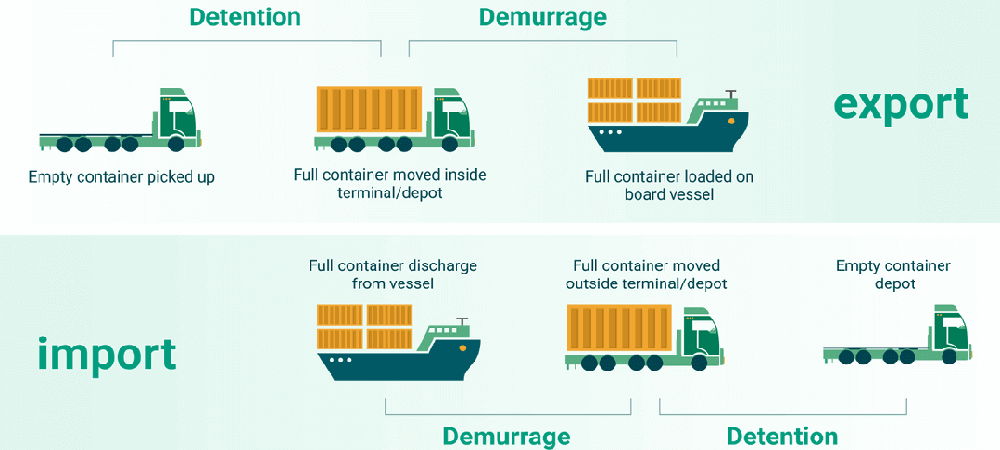
Detention timing—import vs export (simple view)
-
Export detention: starts when you pick up the empty container and ends when the full container is returned into the terminal.
-
Import detention: starts when the full container leaves the terminal and ends when the empty container is returned.
What Is Demurrage? (Plain-English Meaning)
Demurrage is the fee charged by the shipping line when your container stays inside the port/terminal beyond the free time allowed.
In reality, demurrage usually happens when:
-
customs clearance is slow
-
port congestion blocks appointments
-
documents are wrong/incomplete
-
inspections happen unexpectedly
-
you can’t secure drayage/driver slots in time
Once your free demurrage time runs out, the container “sits” and the meter runs daily.
Demurrage vs Detention vs Storage: Don’t Mix These Up
A lot of importers confuse these three, but they are billed for different reasons.
Demurrage vs Detention
-
Demurrage: container stays inside the terminal too long
-
Detention: container stays outside the terminal too long
The port gate is the dividing line.
Demurrage vs Storage
Both look like “fees for keeping cargo too long,” but:
-
Demurrage is charged by the shipping line (container usage compensation).
-
Lagerung is charged by the port/terminal (yard space usage and congestion control).
In many ports, you can sometimes negotiate demurrage extensions (case-by-case), while terminal storage is much harder to waive.
How Demurrage and Detention Fees Are Calculated
Shipping lines typically use a tiered structure: the longer you exceed free time, the higher the daily rate.
Demurrage formula (typical)
Demurrage = (Daily Rate) × (Days Beyond Free Time) × (Number of Containers)
Example concept:
-
Free demurrage: 7 days
-
Your container stays 10 extra days
-
First 5 days at $100/day, next 5 days at $150/day
-
Multiply by number of containers
Detention formula (typical)
Detention = (Daily Rate) × (Days Beyond Free Time) × (Number of Containers)
Same idea: tiered daily rates + number of containers.
Important reality: Free days and rate tiers vary by shipping line, port, container type (20GP/40HQ), and sometimes by season.

The Real Causes Behind These Fees
Common demurrage triggers
-
customs documents not ready
-
HS code/classification disputes
-
missing licenses/certificates
-
physical inspection holds
-
port congestion and appointment delays
-
payment holds (duties/taxes not paid in time)
Common detention triggers
-
no available warehouse dock time
-
slow unloading (labor shortage, congestion)
-
delays returning empty containers
-
chassis shortages (in some markets)
-
empty return depots far away or fully booked
How to Avoid Detention Fees (Practical Tips)
1) Plan unloading before the vessel arrives
If you wait until the container lands to think about unloading, you lose days immediately. Book:
-
warehouse slot
-
labor
-
unloading equipment
-
return depot plan for empties
2) Use “unload at yard” or transload options where possible
In some locations, you can negotiate unloading or transloading in a yard/warehouse near the port. This can speed up the empty container return and reduce detention risk.
3) Ask for more free detention days early (when you have leverage)
If you ship multiple containers or have a stable route, forwarders sometimes can negotiate better free time. It’s not guaranteed, but it’s more realistic vor the container is already late.
How to Avoid Demurrage Fees (Practical Tips)
1) Pre-clear customs whenever allowed
For some destinations, you can submit documentation early so customs can process before arrival. Even when full pre-clear isn’t possible, earlier submission reduces “paper delay” risk.
2) Prepare a “document-ready checklist” per product category
Different products require different paperwork. A few examples:
-
wood products may require origin + phytosanitary/fumigation documents
-
electronics may require CE/FCC/RoHS-type compliance (market dependent)
-
cosmetics/food-contact items may need special declarations and testing
3) Secure drayage and appointments early
In busy ports, the container may be released but you can’t get a pickup slot. Booking a trucker early can be the difference between zero demurrage and a painful bill.
4) Choose smarter ports and routes
A cheaper ocean rate is useless if the destination port is consistently congested and unpredictable. Sometimes a slightly different port + domestic trucking is more stable overall.
Where Ucsourcing Helps (Yiwu Agent + Logistics Coordination)
If you source from multiple suppliers (common for Amazon sellers, wholesalers, and chain retailers), the logistics risk increases because consolidation, labeling, repacking, and document matching must be perfect.
Ucsourcing helps you reduce detention/demurrage risk by managing the full chain:
-
supplier follow-up + production timeline control
-
consolidation in Yiwu and shipment planning
-
export documentation alignment
-
packaging/labeling/kitting to avoid customs issues
-
coordination with reliable forwarders
Explore:
Contact Us (To Reduce Surprise Logistics Fees)
If you want us to review your shipment plan and identify the highest-risk points that lead to demurrage/detention—especially for FCL/LCL imports—reach out:
Ucsourcing
-
WhatsApp: +86-18026272594
-
E-Mail: [email protected]
-
Adresse: Nr. 201, Gebäude 56, 8. Straße, Bezirk Changchun, Stadt Yiwu, China 322000